$$$ KPO and CZM $$$: fundamental analysis
Showing posts with label fundamental analysis. Show all posts

Wednesday, July 3, 2019

Combination of Ascott REIT and Ascendas Hospitality Trust

People are sort of expecting this to happen but this was simply too sudden! Given that the Ascendas-Singbridge acquisition just completed a few days ago?! Anyway, I am not sure why they are calling it a combination instead of a merger but I guess it is because they already owned it?

What is Happening?


Ascott REIT shareholders:
Nothing to get too excited about.

Ascendas Hospitality Trust shareholders:
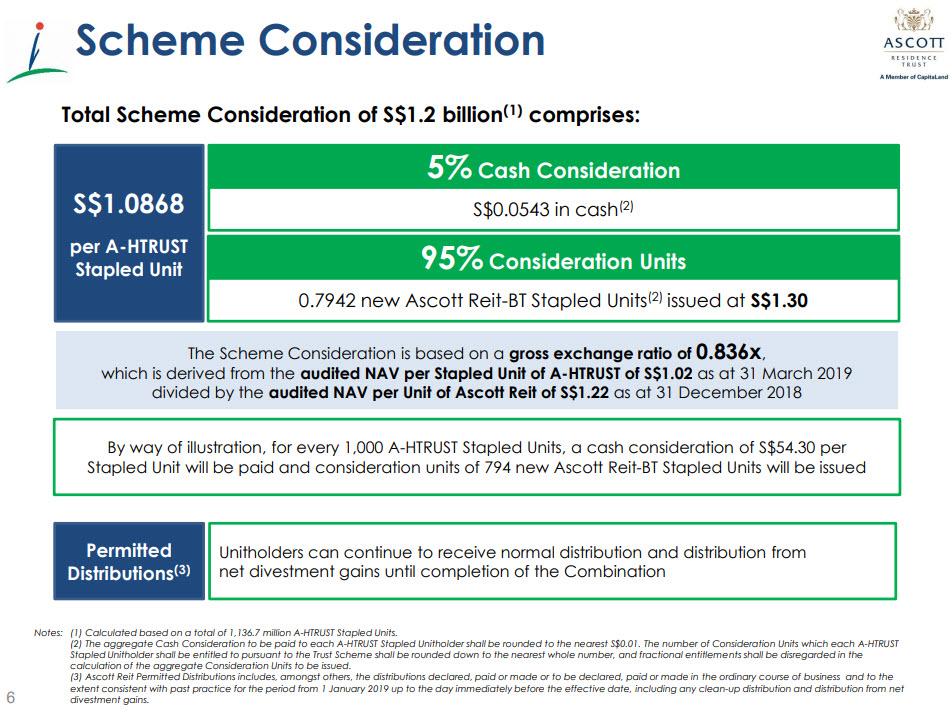
Ascott REIT will be buying over your shares! This will comes in the form of $0.0543 cash/dividends + 0.7942 of new Ascott REIT-BT shares. Value unlocked? It really depends on how one looks at it.

Let's look back at one of our posts where I blogged about the open letter by Quarz Capital in our Portfolio - April 2019 and decided to buy more Ascott REIT.


As you can see, the offer is pretty similar to what Quarz Capital proposed - a mixture of cash (lesser) and Ascott REIT share (more) offer at a 5-10% premium to book value. In my opinion, the offer is quite fair and it does unlock the value for Ascendas Hospitality Trust. The next question will be is this better for Ascott REIT and/or Ascendas Hospitality Trust shareholder?

NAV and DPU


During such event (acquisition/merger), they will always market that it is good for the shareholders but it is not always the case e.g. Another Bad Deal - Merger of OUE Commercial REIT & OUE Hospitality Trust. One glance on the presentation slides or newspaper article will reveal that DPU will improve for both Ascott REIT and Ascendas Hospitality Trust shareholders.

Based on the closing price on 2nd July before the announcement

With more assets and "better" branding, it should be expected/normal for the new entity to trade at higher PB. Unfortunately, the dividend yield actually decreases for Ascendas Hospitality Trust shareholders. The dividend yield increases for Ascott REIT shareholders. On a side note, the pro forma NAV should have been $1.21, decrease by $0.01 including all the fees/costs but I found it amusing that they only stated that in the fine print and marketed it as DPU accretion, NAV neutral. lol.

Arbitrage Opportunity


Based on the latest closing price of both shares on 3rd July 2019, buying Ascendas Hospitality Trust still provides an estimated 2.96% return (before fees/commissions and higher return if annualized). Technically, both prices should be "supported" by this combination - Ascott REIT ~$1.30 and Ascendas Hospitality Trust ~$1.08. So whenever Ascott REIT price is > $1.30 or Ascendas Hospitality Trust price is < $1.08 are buying opportunities...

Having said that, nothing is stopping Trump from pulling any stunt that will lead to the whole market turning red again. In addition, with both stock prices at an all-time high, the chances of them falling is definitely much higher.

Indicative Timeline


Simply buying Ascendas Hospitality Trust when it is below $1.08. What's the risk? If you look at the indicative timeline, you will know that it is not happening immediately and has to be voted by the shareholders during the October 2019 EGM. There is a possibility of it not happening. Imagine market sentiment turns weak and Ascott REIT price falls to $1.10 (back in December 2018). The combination/merger will be an immediate loss for Ascendas Hospitality Trust shareholders!

Odd Lots


If you are wondering if there is any way NOT to end up with odd lots, the answer is going to disappoint you. You will almost definitely end up with odd lots but you can definitely try to end up with the least odd lots. A realistic example - if you have 3000 Ascendas Hospitality Trust shares now, you can buy 400 more shares so that you will be given 2700 Ascott REIT shares. This will only make sense if you have no minimum commission. Otherwise, you will be better off with odd lots.

I would have preferred more cash to be paid out vs getting new Ascott REIT shares at $1.30. Oh well, we are sitting on decent profits for both stocks so not going to complain further. So will you buy or bye?


You can find the spreadsheet here:
- Combination of Ascott REIT and Ascendas Hospitality Trust Calculator

You can refer to the official announcements here:
- Ascott REIT Announcements
- Presentation Slides

Do like any of the following for the latest update/post!
1. FB Page - KPO and CZM
2. Twitter - KPO and CZM
3. Click here to subscribe using email :)
4. Instagram - KPO_and_CZM (Did you see those delicious food photos to the right --> Unfortunately, you can't see it on mobile.)

Tuesday, August 14, 2018

Capitaland - An Undervalued Blue Chip?

Capitaland needs no introduction. It is currently the 2nd largest investment in our portfolio and we have recently bought more of it even after the cooling measure.


The green arrow indicates that the latest action within 14 days is an increase in position. To be exact, we bought 1,000 @ $3.13 on 6th August 2018. Besides busy preparing for our wedding, I have been spending some time working on a side project.

The idea is simple and is based on mean reversion which means that everything will return to their mean/average eventually. I first load a bunch of historical stock prices and pull out 3 different financial numbers (NAV, EPS and DPS) from past annual reports.


These numbers will allow me to compute the various financial ratios (PB, PE and Dividend Yield). If you have no idea what they meant or what I am talking about, do read up more first.

1. From 2002-01-02 to 2018-08-10 


That is more than 16 years of data! The annualized return excluding dividends is 3.37%. Unfortunately, the annualized return including dividends is still a work in progress. Note that the mean price is $3.39.


Stock price by itself is meaningless hence the need to use various financial ratios. Based on these data, the mean PB is 1.03, the mean PE is 13.44 and the mean dividend yield is 3.01%. This allows one to know if a stock is undervalued or overvalued simply by looking if the current financial ratios are above/below the mean. To take it further, I try to predict the target price/upside by using the average of both the mean and median.

Current Price (2018-08-10): $3.31 (below mean price)
Predicted Price based on PB: $4.15 (25%)
Predicted Price based on PE: $3.82 (15%)
Predicted Price based on Dividend Yield: $4.13 (25%)

2. From 2010-01-02 to 2018-08-10 


One of the issue/limitation is that the mean can be easily skewed. Before the financial crisis, Capitaland actually once traded at around > $8, PB > 2 and PE > 30! Looking at data after the financial crisis (2010) will remove those ridiculous numbers. Notice how after investing for 8 years, one can actually be sitting at a paper loss (-2.70%) excluding the dividends? The mean price is $3.30 (lower as compared to the above).


The mean PB is 0.881, the mean PE is 12.45 and the mean dividend yield is 2.73%. You can see that the numbers are lower, hence more conservative.

Current Price (2018-08-10): $3.31 (above mean price)
Predicted Price based on PB: $3.79 (15%)
Predicted Price based on PE: $3.64 (10%)
Predicted Price based on Dividend Yield: $4.37 (27%)

3. From 2014-01-02 to 2018-08-10 


After all, 8 years is a long time. The policies/cooling measures then would have been very different from what we have now. If I were to use more recent data (within the last 5 years) to account for the more recent changes, interestingly the mean price remains at around $3.30. We are back to a positive annualized return of 2.01% excluding dividends.


The mean PB is 0.817, the mean PE is 11.41 and the mean dividend yield is 3.11%.

Current Price (2018-08-10): $3.31 (above mean price)
Predicted Price based on PB: $3.56 (7%)
Predicted Price based on PE: $3.39 (2%)
Predicted Price based on Dividend Yield: $3.80 (15%)

Investing is not as simple as just looking at these few numbers. Otherwise, all the mathematician will be millionaires. Hahaha. Notice how by changing the period/historical data, a different picture will be painted? The same stock/investment can be giving one investor positive paper gain over the years and negative paper loss to someone else. Hence, the entry price is pretty important. Having said that, I have yet to include dividends and I do believe the return should all be positive after that.

Is Capitaland an undervalued blue chip? I will leave it to you to decide :)

Do like any of the following for the latest update/post!
1. FB Page - KPO and CZM
2. Twitter - KPO and CZM
3. Click here to subscribe using email :)
4. Instagram - KPO_and_CZM (Did you see those delicious food photos to the right --> Unfortunately, you can't see it on mobile.)

Tuesday, June 5, 2018

What is Happening to Singtel?

Singtel (Singapore Telecommunications Limited) needs no introduction, it is a familiar name for everyone. Based on its latest results, it seems like it was an excellent year for Singtel at a glance.


Record net profit + the whole year this up and that up, only Q4 down, why would the price keep falling?! It is currently at a 5 years low (based on ShareInvestor). Why?


The record net profit is largely bumped up by the divestment on Netlink Trust which was recorded as an exceptional item (gain) of $1.93 billion. If we were to remove this gain from the record net profit of $5.45 billion, we will get $3,500 billion which is lesser than FY 2017 $3,853 billion.


Once we adjust its net profit, it becomes more evident that Singtel is not trading as "cheaply"/undervalued as it is, with its previously inflated earnings/EPS. Using the given EPS of 33.40 cents would mean that some of you may compute Singtel PE as ~9.79 (3.27 / 0.334). Realistically, the adjusted EPS should be ~21.42 cents giving a PE of 15.27 (3.27 / 0.2142). Not so surprising as to why the price has fallen so much anymore right? So why did we buy more Singtel? There are actually many many reasons. lol.


Firstly, I took some time to compile the financial numbers for the last 5/6 years to compute its PB, PE and dividend yield based on the closing price one day after the full year result was announced. Although PB is not relevant for Singtel, it is still worth noting that at the current price, Singtel is trading below its average and median PB and PE since 2013.

In addition, Singtel has "promised" to maintain dividends at 17.5 cents for the next two financial years. The price which we entered ($3.30) meant that we would be getting a dividend yield of ~5.3%. The next question to ask is will the dividends be sustainable? If you were to look at its FCF (Singtel Free Cash Flow = Net cash from operating activities - Payment for purchase of property, plant and equipment), you will see that its FCF is still relatively healthy and the dividend payout ratio is below 1. Hence, the dividends are in fact very sustainable.


Singtel businesses can be broken down into the above 3 groups - Group Consumer, Group Enterprise, and Group Digital Life. The general public impression of Singtel business is from the Group Consumer (the mobile, broadband, etc.) which contributes the most revenue, is unfortunately declining and facing fierce competitions. One example is Circles Life who recently launched a Flexi Plan for $0?!


Looking at the breakdown of the revenue, we can see that Singtel is trying to move the dependency of its revenue from the Group Consumer business by growing the other 2 businesses. It is also interesting to see the huge growth in the revenue of Group Digital Life (~100%) but I am pretty puzzled as to why it is still making losses (2013: make $111, lost $145. 2018: make $1,080 but still lost $120?!). The declining revenue/net profit of its businesses is the main cause of the drop.


Last but not least, are you familiar with the saying that banks that are too big to fail? Going by this logic, Singtel being larger than 2/3 banks would similarly be too big to fail. lol.


I am serious! Look at the top 2 substantial shareholders! Hahahaha.

On a side note, KPO started working on a new project to ingest stocks data in order to increase his efficiency in screening stocks, remove the typical limitation of 3/5 years stock data and to visualize them. The dashboard that I have created is still at its infant stage but looks cool enough for now. lol.


If you believe in mean reversion, Singtel current share price ($3.27) is way below its mean price of $3.799 using data from 2013. However, the mean price will always be limited/affected by the dataset that is available and the timeframe used for computation.


If I were to expand the dataset further to 2008, the mean price would be much lower at $3.48 due to the financial crisis. The current price is still below the mean :)


In comparison, SPDR STI ETF (ES3) is trading above its mean price since 2008. Time to sell? lol.

Do like any of the following for the latest update/post!
1. FB Page - KPO and CZM
2. Twitter - KPO and CZM
3. Click here to subscribe using email :)
4. Instagram - KPO_and_CZM (Did you see those delicious food photos to the right -->)

Thursday, May 10, 2018

Frasers Logistics & Industrial Trust Preferential Offering

Frasers Logistics & Industrial Trust just concluded its private placement (KPO did not get an offer this time round unlike Keppel DC REIT Private Placement which was a pleasant surprise!) and provided more information on the preferential offering to fund its proposed acquisition of 21 prime industrial properties in key global logistics hubs in Germany (17) and the Netherlands (4). You can find the official announcement here.

Some of the readers may know that KPO secretly loves rights issue as it provides an opportunity for existing shareholders to increase their investment at a much lower cost and without any commission as compared to buying off the market. Having said that, not all rights issue is good and there is a need to evaluate whether the cash call is beneficial to the existing shareholders.


Current/Latest Numbers
Price: $1.09
Dividend/Distribution Per Unit (DPU) for FY2017: $0.0701
Dividend Yield (Assuming DPU remain constant for FY2018): 0.0701 / 1.09 = 6.43%
NAV (2QFY18): S$0.91 (Based on exchange rate of A$1.00 : S$1.0125)
PB: 1.198 (19.8% premium!)
Gearing: 30.5% (MAS limit is 45%, the lower the better)
WALE (Weighted Average Lease Expiry): 6.75 years (the higher the better)
Total shares based on 2QFY18 (including manager's fees): 1,523,985,999

Private Placement:
333,199,000 units at an issue price of S$0.987 per unit (initial issue price range: between S$0.962 and S$0.987)

Preferential Offering:
A pro rata and non-renounceable preferential offering of 152,153,437 new units on the basis of 1 new unit for every 10 existing units at an issue price of between S$0.942 and S$0.967. Given that the issue price of the private placement was priced at the upper bound, we can expect the same for the preferential offering.


Do note that the numbers are just estimated and the assumption is that the acquisition happened since listing/IPO date to 30 September 2017. Looking at the DPU in Australian cents, the acquisition is probably (remember the numbers are just an illustration) slightly yield accretive. They have also conservatively kept the exchange rate at A$1 : S$1.


The NAV remained roughly the same after the acquisition based on the provided illustration. What I do not like is that the gearing ratio would increase from 30% to 36% for a measly increase of 1.7% in DPU and no change in NAV. On the bright side, WALE will be increased to 7.1 years and the acquisition is not diluting the yield while a preferential offering allows existing shareholders to join in the fun.


We have 8,000 shares currently at an average price of $0.962. As a result, we would have 800 non-renounceable (means it cannot be sold - either exercise it or let it expire) shares.

If the issue price is S$0.942, we will be looking at:
Dividend Yield (Assuming DPU remain constant for FY2018): 0.0701 / 0.942 = 7.44%
PB: 0.942 / 0.91 = 1.035 (3.5% premium)

Average Price: (0.962 * 8,000 + 0.942 * 800) / 8,800 = $0.960
Average Yield: 0.0701 / 0.960 = 7.30%

If the issue price is S$0.967, we will be looking at:
Dividend Yield (Assuming DPU remain constant for FY2018): 0.0701 / 0.967 = 7.25%
PB: 0.967 / 0.91 = 1.063 (6.3% premium)

Average Price: (0.962 * 8,000 + 0.967 * 800) / 8,800 = $0.962
Average Yield: 0.0701 / 0.962 = 7.28%

If you are not an existing shareholder and are thinking of joining the fun, you will be looking at the following numbers instead:
Average Price: (1,000 * 1.09 + 100 * 0.967) / 1,100 = 1.079
Dividend Yield (Assuming DPU remain constant for FY2018): 0.0701 / 1.079 = 6.50%
PB: 1.079 / 0.91 = 1.19 (19% premium)

You will be entitled to S$0.043 dividends but do take note of the potential capital loss at an average price of $1.079. The price would definitely drop significantly by 18th May when it goes XD and XO.

Regardless, with the preferential offering, CZM and I will be looking at a sustainable (long WALE, high occupancy) dividend yield of > 7% which is pretty decent. The fun part which I love is the ability to oversubscribe, the more the merrier!

Update on 25th May 2018: Subscribe to 800 and oversubscribe by 6,200!

Do like any of the following for the latest update/post!
1. FB Page - KPO and CZM
2. Twitter - KPO and CZM
3. Click here to subscribe using email :)
4. Instagram - KPO_and_CZM (Did you see those delicious food photos to the right -->)

Monday, May 7, 2018

Keppel DC REIT Private Placement

Keppel DC REIT requested for a trading halt earlier and launched a private placement of 224,000,000 shares at an issue price of $1.353 per share to raise gross proceeds of approximately $303.1 million. You can refer to the official announcement here. Let's look at the numbers!


Current/Latest Numbers
Price: $1.43
Dividend/Distribution Per Unit (DPU) for FY2017: $0.0712
DPU Excluding a one-off capital distribution of S$1.7 million or 0.15 cents for FY2017: $0.0697
Dividend Yield (Assuming DPU remain constant for FY2018): 0.0697 / 1.43 = 4.87%
NAV: $0.97
PB: 1.47 (47% premium!)


Gearing: 37.4% (MAS limit is 45%, the lower the better)
WALE (Weighted Average Lease Expiry): 9.6 years (the higher the better)
Total shares based on 2018Q1 (including manager's fees): 1,127,275,000

Long portfolio WALE provides income stability for the REIT (the longer the better) hence it is fairly conservative to assume DPU remain constant for this year as well. This is probably one of the reasons why Keppel DC REIT is trading at such a huge premium!


Do note that the numbers are just estimated and the assumption is that the acquisition happened on 1st January 2017 and rental are collected for the FY2017. This is not a projection/promise for FY2018. The NAV after the acquisition would be around $1.03. At the issue price of $1.353, the PB would be 1.31 which means I would be getting it at a premium of 31% instead of 47%!


It seems that the DPU will be affected by some IRAS rules as well which I am clueless about but if you are interested, you can read about it here - Income Tax Treatment of Real Estate Investment Trusts and Approved Sub-Trusts. Given the above numbers, I will try to project a much more conservative yield I should be expecting by using the worst case scenario/numbers if I were to subscribe to the private placement.

Distributable Income (no tax transparency and excluding a one-off capital distribution): $97,810,000
Issued Units (using the latest issued units from 2018Q1 instead of FY2017): 1,127,275,000 + (1,351,990,000 - 1,127,171,000) = 1,352,094,000
DPU = $97,810,000 / 1,352,094,000 = $0.0723?! (higher than $0.701 with a larger base/shares?)


Weird. Now I am confused by the numbers, no matter how I calculate/reverse the computation, I cannot tie/tally the numbers... 97,810 / 1,351,990 != 7.01! Although it clearly states that the distributable income has already excluded the one-off capital distribution of $1.7 million. Now that I look closely at it, even 82,300 / 1,127,171 != 7.12. I guess I probably oversimplify the numbers and the only way to proceed is to use whatever number that was given.

Dividend Yield: 0.0701 / 1.353 = 5.18%

In addition, the gearing will improve to 32.1% from 37.4% which will give them more opportunity to acquire more assets and improve DPU in the future. As technology advances, data have become increasingly important for every business. Guess what would be needed to do that? lol. The numbers definitely look more decent as compared to buying it off the market.


Another thing which I observe is that Keppel DC REIT declares distributions on a half-yearly basis (payment months are in February and August). This would be aligned with our DBS Multiplier strategy which I blogged about here - DBS Multiplier + SSBs + Joint Account = Higher Interest! With this REIT in our CDP, we can probably skip the SSB for August 2018.

All these while, I have been diluted by private placement. This is our first time receiving a private placement offer and it is finally our turn to dilute existing shareholders. Wahahahaha. Since the stock halted at $1.43, the share price will probably fall once it resumes trading. If you are comfortable with the above numbers, you can consider buying some if the price is lesser or around $1.353 :)

Do like any of the following for the latest update/post!
1. FB Page - KPO and CZM
2. Twitter - KPO and CZM
3. Click here to subscribe using email :)
4. Instagram - KPO_and_CZM (Did you see those delicious food photos to the right -->)

Thursday, April 26, 2018

Ezion - Bleeding Stopped!

I blogged about Ezion a few months back - Bleeding Stocks - Ezion [Part 3] after it was suspended on 8th August 2017. It has resumed trading last week on 17th April 2018, opened at $0.245 and even reached a high of $0.255!

CZM was asking me what would be my plan when Ezion resumes trading. I told her confidently that day 1 will be a bloodshed as I foresee everyone will be dumping and selling their shares. My plan was to hold it, be hopeful and see how things go. Surprisingly, it was beyond my expectation and it actually traded higher! Without any hesitation, I submitted a sell order and sold all of it at $0.225.


Investing in stocks is never easy and one does not always make money. My total capital was $6,167.70 and I am pretty glad that I manage to get back $2,222.26 after ~ 4 years. I lost in total $3,939.30 including commisions which translate to a total loss of -63.9% and an annualized loss of -37.9%! It could have been much worst - the latest closing price is $0.152 on 25th April 2018.


Looking at their 2017 Annual Report, the shares are now worth a lot lesser than it was one year ago. The equity attributed to shareholders is just US$304,826,000 as compared to US$1,315,384,000 partly due to the ridiculously large impairment losses of US$697,322,000 in their Plant and Equipment among other things. Furthermore, the decrease in cash is not proportionate to the decrease in liabilities too!


NAV has decreased by 76.8% from US$0.6343 to US$0.1470 (~SG$0.1940 using an exchange rate of US$1:SG$1.32). Regardless, the US$1.6 billion debt is an exceptionally huge one that will probably stick around its balance sheet for a long time and I am not too optimistic about it with a gross profit of US$1,804,000. Even if Ezion successfully multiplies its gross profit by 10x or even 100x, it will never be the same again.

Screenshot from https://sginvestors.io/sgx/stock/5me-ezion/target-price

Do not make the same mistake as I did when I first started investing 4 years back - buying based on analyst's report recommendation. Look at what DBS has done again with a BUY recommendation and a price target of SG$0.29 where the valuation is done at 1.4x FY2018 PB?! It is just so wrong! After all the drama, why would anyone still value/price Ezion at a premium?

One can either continue to be hopeful or cut loss, take whatever there is now. Assets can be impaired but liabilities will definitely remain. Good luck to the remaining shareholders!

Do like any of the following for the latest update/post!
1. FB Page - KPO and CZM
2. Twitter - KPO and CZM
3. Click here to subscribe using email :)
4. Instagram - KPO_and_CZM (Did you see those delicious food photos to the right -->)

Thursday, March 29, 2018

Tuan Sing

Company Description from SGX StockFacts - Tuan Sing Holdings Limited, an investment holding company, engages in the property development and investment, hotels investment, and industrial services businesses in Singapore, Australia, China, Malaysia, Indonesia, Europe, and other ASEAN countries. Its Property segment develops and invests in residential, commercial, and industrial properties; and provides property management services. The company’s Hotels Investment segment owns two five-star hotels managed by Hyatt International in Melbourne and Perth, Australia.


Tuan Sing has always been on my watchlist and I have finally decided to enter it this week at $0.42. It was first brought to my attention by a friend last year but I did not buy because there were other opportunities or its price has gone up. Since then, UOB has published a buy report and B from ForeverFinancialFreedom (Recent Action - Tuan Sing) has accumulated some too.


What I like about the company is that most of its properties are freehold. Some of the properties are at prime locations such as 18 Robinson and Robinson Point and there are others not captured in the above screenshot. Most importantly, it is currently trading at a steep discount (PB of 0.505).

Tuan Sing Sector Comparison by ShareInvestor

Its NAV based on the latest annual report is $0.83. Assuming if it was to trade at the industry average PB of 0.6594, the price would be around $0.545 (~30% upside from current entry price). What really caught my attention and led me to pull the trigger is the letter to shareholders. One of its agenda for the upcoming AGM is the renewal of the share purchase mandate.


By doing shares buyback and keeping the shares as treasury shares, it reduces the number of issued/outstanding shares. This has an opposite effect as compared to rights/bonus issues (dilution on existing shareholders). The chairman gave 5 reasons/rationale for the share purchase mandate, do take a look if you are interested. If the mandate is approved, its NAV will increase to $0.868 - $0.870 because there are now lesser shares available for the same underlying assets. What a bargain!


Looking at its past 5 years performance, shareholders' funds and NAV has been increasing year on year. Dividend has been kept constant/increasing slowly over the years since 2010 and the yield is around 1.7%.


During Oct 2014, it traded at a high of $0.475 with NAV of $0.683 (PB of 0.695). Over the next few months, it went to as low as $0.27 and has never "recovered" despite increasing NAV and dividend. 


It is certainly not due to its corporate governance as Tuan Sing was ranked 7th out of 606 listed companies in Singapore based on the Governance & Transparency Index (GTI). This is a collaboration between CPA Australia, NUS Business School's Centre for Governance, Institutions, and Organisations (CGIO), and Singapore Institute of Directors (SID) and you can find out more information here.

So why is it trading at such a steep discount? Your guess is as good as mine. Slumpy earnings? Low dividend yield? Tuan Sing explicitly states in its Dividend Policy that "The Company’s priority is to achieve long-term capital growth for the benefit of shareholders. Most of its profits, when made, shall therefore be retained for investment into the future." Even my DBS Multiplier is giving higher interest rate than the dividend yield. lol. Regardless, this is an investment for one with patience :)

Happy long weekend everyone!

Do like any of the following for the latest update/post!
1. FB Page - KPO and CZM
2. Twitter - KPO and CZM
3. Click here to subscribe using email :)

Thursday, February 1, 2018

Ascendas Hospitality Trust

With the market running up so much and STI hitting a multi-year high, it has been harder and harder for us to buy stocks. Everything seems so expensive until today! Our latest buy - Ascendas Hospitality Trust 9000 units @ $0.895 :)

Ascendas Hospitality Trust Valuation and Properties

Let me give a quick introduction to Ascendas Hospitality Trust. It has 11 9 properties in 7 6 cities, 4 3 countries (Australia, China, Japan and Singapore) valued at $1.6 Billion. Based on the last quarter financial statement, its current NAV is was at $0.891 which translate to a PB of 1.01.

Ascendas Hospitality Trust Stock Fundamentals

However, on the 29th January 2018 (after market close), Ascendas Hospitality Trust announced that it will be divesting its China investment/properties at a premium of 101.5% above the Independent Valuation. You read that right.


This divestment meant that its NAV would shoot up. Note that the numbers are generated with the assumption that the divestment has taken place at 31st March 2017. The total number of shares/stapled security would have increased since then. Using the latest (2Q) financial statement, a more realistic NAV should be [1.02 - (0.92 - 0.891)] * 1,124,481 / 1,127,553 ~ $0.988 which translate to a PB of 0.905 (at a discount)! I am expecting it to trade closer to PB of 1 which is around $0.99.

Ascendas Hospitality Trust Net Property Income (NPI) by Geography

Looking at the annual report FY2016/2017, China contributed 8% of the Net Property Income (NPI). A conservative assumption is that the DPU (Dividend Per Unit) will be impacted by the same percentage, 5.68 * 0.92 ~ 5.22 which translate to a 5.8% dividend yield. This is on the low side but it certainly has room for improvement through yield accretive acquisitions because it has the cash/lower gearing going forward (~20+%).

I made all these calculations while I was on a bus traveling to work yesterday and decided to queue for it before market open. Blogging it down to see how wrong/right I am as its 3Q financial statement will be out today after trading hours.


On a side note, APAC Realty went up by 9% crazily (no announcement) yesterday to close at $1.08. At least I am right for this analysis and am sitting on a 25% profit (for now)!

Do like any of the following for the latest update/post!
1. FB Page - KPO and CZM
2. Twitter - KPO and CZM
3. Click here to subscribe using email :)
4. Instagram - KPO_and_CZM (Did you see those delicious food photos to the right --> Unfortunately, you can't see it on mobile.)